
Summary:
Movies based on Mythology continues to influence modern cinema, evolving from ancient epics to contemporary superhero narratives. Films that resonate emotionally often treat mythology as a framework for exploring human experiences like fear, desire, and identity. While Greek and Norse myths dominate Western screens, there's a growing interest in diverse mythologies. Successful adaptations balance spectacle with meaningful storytelling, ensuring myths remain relevant by addressing universal human questions.
Tagline: From Olympus to the MCU, from sacred epics to superhero sagas, mythology never actually left the big screen—it just changed costumes.
These are captivating movies based on Mythology.
Why mythology still haunts the silver screen
Mythology is cinema’s oldest collaborator. Long before Hollywood had sound stages and superhero franchises, early filmmakers were staging the labors of Hercules and the wrath of gods in flickering black and white. What we see today—the blockbusters, the crossovers, the CGI titans—is just the latest chapter in a storytelling tradition older than written language itself.
But here’s the twist: the most powerful mythological movies aren’t always the ones with the biggest budgets or the loudest explosions. The films that linger are the ones that recognize mythology as emotional architecture, not just production design—stories built on fear, desire, pride, sacrifice, and the impossible negotiation between being human and wanting to be more than human.
In this guide, we’ll look at how modern cinema rewires ancient myths, why certain pantheons dominate the screen, where Hollywood stumbles, and how mythology keeps evolving into our modern superhero stories.
The eternal appeal of gods and monsters
Mythology arrives preloaded with themes filmmakers crave: love and betrayal, hubris and downfall, fate and free will, and the uneasy relationship between humans and the powers that shape their world. Adapting The Odyssey or reimagining Norse myth isn’t like adapting a recent bestseller—these stories have already been stress-tested over centuries of retelling.
Unlike historical dramas or rigid literary adaptations, myth-based movies have room to bend reality. No one is fact-checking whether Zeus really transformed into a swan or whether Loki actually gave birth to an eight-legged horse. That creative freedom lets directors smuggle contemporary anxieties—about war, empire, technology, and identity—into familiar narrative shapes that audiences instinctively recognize.
The paradox is that spectacle alone rarely feels mythic. A movie can have gods, monsters, and oceans of CGI and still feel emotionally small. The films that work treat mythology not as a checklist of creatures and miracles, but as a language for talking about what it means to be human.
Greek mythology: Hollywood’s favorite battleground
Why Greek myths dominate Western cinema
Greek mythology is tailor-made for Western cinema: it’s sensual, violent, psychologically intense, and dripping with family drama that could embarrass a prestige TV writers’ room. You get tragic love stories, doomed heroes, capricious gods, and a pantheon that behaves with the insecurity and pettiness of deeply flawed humans.
From Jason and the Argonauts to Clash of the Titans, from art-house reinterpretations to summer tentpoles, Greek myth is Hollywood’s home base when it comes to the ancient world.
If you love exploring how ancient stories evolve across cultures and cinematic eras, you’ll find even more myth‑shaped guides across our Streaming and Character Psychology categories. For films that examine how narrative shapes our understanding of power, identity, and the worlds we build, our guide to movies like The Truman Show explores the modern myths we create about truth and perception. If you’re drawn to character‑driven stories that echo heroic tests, ambition, and legacy, explore our breakdown of movies like The Social Network, a contemporary tale that functions like a digital‑age origin myth. And for viewers who love stories that reclaim overlooked histories with emotional resonance, our guide to movies like Hidden Figures highlights narratives that reshape who gets to stand at the center of our shared mythology. For more psychologically rich, myth‑infused storytelling, explore our full archive of streaming guides.
Troy (2004): Removing the gods to expose the humans
Wolfgang Petersen’s Troy made a controversial choice: it stripped the Iliad of its gods and divine interventions, reframing the Trojan War as a purely human conflict. Instead of Zeus and Athena playing war games, we get kings, soldiers, and lovers driven by pride, grief, and ambition.
Brad Pitt’s Achilles isn’t a glowing demigod; he’s a man terrified of being forgotten, obsessed with legacy, and painfully aware of his mortality. By removing the divine safety net, the film forces the audience to confront the cost of human decisions—not the whims of Olympus.
Percy Jackson: Gods in Modern America
The Percy Jackson films—and the later Disney+ series—take the opposite route. They lean into the fantastical and relocate the Greek gods into modern America. The core idea that the gods move wherever the “heart of Western civilization” currently beats is a clever narrative hack: it lets ancient myth explain contemporary culture.
Even if the execution is uneven, the concept is potent. It suggests that myth isn’t a museum piece; it migrates, mutates, and adapts to new empires, new technologies, and new anxieties.
Wonder Woman: Myth as metaphor for human potential
Wonder Woman filters Greek mythology through the lens of superhero storytelling and historical trauma. By rooting Diana’s origin in the gods while placing her in World War I (and later the 1980s), the films create a bridge between mythic timelessness and very specific human horrors.
It’s not just about a demigoddess in armor; it’s about how belief, compassion, and moral conviction survive in a world obsessed with power and cynicism.
Norse Mythology: From Wagner to the MCU
Norse mythology experienced a massive renaissance thanks to Marvel's Thor franchise. Before 2011, most Americans couldn't tell Odin from Loki, but now these names are household fixtures. Marvel's interpretation takes enormous liberties—turning gods into aliens, and Asgard into a sci-fi realm—yet somehow captures the essence of Norse cosmology's emphasis on fate, sacrifice, and renewal.
What Marvel understood that previous Norse adaptations missed was the humor inherent in these stories. The original myths feature Thor cross-dressing to retrieve his hammer and Loki transforming into a mare and giving birth to an eight-legged horse. These aren't stuffy, reverent tales—they're wild, sometimes absurd adventures that benefit from a lighter touch.
The “Thor” films work because they embrace both the cosmic scale and the family drama at mythology's heart. Watching Thor, Loki, and Odin navigate their complicated relationships feels authentic to the source material's emphasis on kinship and betrayal, even when they're doing it against a backdrop of rainbow bridges and dark elves.
The Power of Humor in myth
Norse myths are stranger and funnier than their grim, “ancient and serious” reputation suggests. Thor cross-dresses to reclaim his hammer, and Loki shape-shifts into a mare and gives birth to Odin’s eight-legged horse. These are wild, sometimes absurd stories, and Marvel’s willingness to embrace humor (especially in Thor: Ragnarok) is surprisingly faithful to that spirit. While Western cinema gorges itself on Greek and Norse mythology, Eastern traditions remain comparatively underused—and when Hollywood does try, the results can feel clumsy, reductive, or tone-deaf. That’s a missed artistic opportunity and a reminder of how uneven cultural representation still is.
Chinese Mythology: The Monkey King and beyond
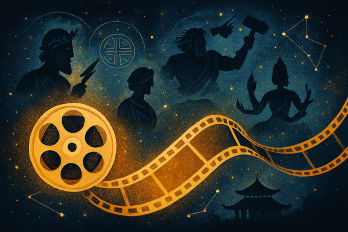
Chinese mythology offers cosmologies and epics on a scale that makes even Olympus feel small. The Monkey King stories and Journey to the West have been adapted countless times in Asian cinema and television, sometimes as slapstick comedy, sometimes as spiritual allegory.
Western attempts often stumble because they treat these tales as exotic fantasy instead of living traditions with religious, philosophical, and cultural weight. Stephen Chow’s Journey to the West (2013), for instance, works precisely because it modernizes the story while understanding its spiritual core.
Japanese mythology and folklore on screen
Japanese mythology frequently reaches Western audiences filtered through horror or supernatural thrillers. Movies like Onmyoji, anime series, and countless yokai stories blend folklore with modern anxieties. Hollywood’s attempts, such as 47 Ronin, often try to hybridize history and myth with mixed results—unsure whether they’re making a grounded samurai drama or a full-on fantasy epic.
Indian mythology, despite the rich tapestry of the Mahabharata and Ramayana, rarely appears in Western cinema beyond exotic window dressing. This absence speaks to larger issues of representation and cultural understanding in Hollywood. When filmmakers do attempt these stories, they often miss the philosophical depth that makes Indian epics so compelling.
Indian mythology, despite the rich tapestry of the Mahabharata and Ramayana, rarely appears in Western cinema beyond exotic window dressing. This absence speaks to larger issues of representation and cultural understanding in Hollywood. When filmmakers do attempt these stories, they often miss the philosophical depth that makes Indian epics so compelling.
Disney’s Hercules: Inaccuracy as style
Disney’s Hercules is wildly unfaithful to Greek myth—and that’s part of why it works on its terms. By leaning into gospel-style muses, neon-colored underworlds, and self-aware humor, the film sidesteps direct comparison with the original myths and embraces mythology as raw material for something new.
Moana: Respectful collaboration with living traditions
Moana blends original storytelling with Polynesian mythological elements, particularly the demigod Maui. The film’s development included collaboration with cultural advisors from across the Pacific, and while it still simplifies, it treats the source traditions as alive and meaningful rather than as a costume closet for set pieces.
Studio Ghibli: Inventing myths that feel ancient
Many Studio Ghibli films—especially Princess Mononoke and Spirited Away—feel like they’re tapping into an existing mythic reservoir, even when the stories are original. Drawing from Shinto ideas and Japanese folklore, these films show how new narratives can feel genuinely mythic without being direct adaptations.
The Prince of Egypt: Biblical myth with emotional weight
DreamWorks’ The Prince of Egypt approaches the story of Moses with a seriousness and visual grandeur rarely given to animated religious narratives in mainstream Western cinema. It treats Exodus not as a trivia quiz to get “right,” but as a lived emotional experience—of doubt, calling, loyalty, and liberation.
Modern myths and superhero cinema
Superhero movies are our modern mythology. That’s not just a metaphor—structurally, they behave like myths. You have origin stories that function like divine birth tales, heroic tests and temptations, villains who embody cultural fears, and recurring characters who are reinvented for each generation.
The Marvel Cinematic Universe and DC films operate as a contemporary pantheon. Characters like Batman, Spider-Man, and Wonder Woman exist in multiple, sometimes contradictory versions—just as ancient mythic figures varied from region to region, poet to poet.
Black Panther: Myth, Ancestry, and futurism
Black Panther explicitly fuses superhero mythology with African traditions and Afrofuturism. Wakanda functions as both a technologically advanced nation and a spiritual space where the ancestral plane is as real as any throne room. The film’s exploration of inheritance, diaspora, and moral responsibility feels mythic in the best sense—epic in scope, grounded in human pain and longing.
The pitfalls of mythological adaptation
When mythological movies fail, it’s rarely because the source material is weak. It’s almost always because the adaptation misunderstands the point of myth—reducing it to cool imagery, stripping away cultural context, or ignoring the emotional and philosophical questions at its core.
Gods of Egypt (2016): A cautionary tale
Gods of Egypt became a case study in how not to adapt mythology. The whitewashing of Egyptian deities, the video-game logic of the plot, and the shallow approach to one of the world’s oldest and richest religious systems produced a film that felt like it had no curiosity about the culture it was borrowing from.
Immortals and the hollow spectacle
Immortals (2011) is visually striking—golden armor, stylized violence, painterly compositions—but the myths feel hollowed out. The result is myth as aesthetic, rather than myth as meaning.
The many failed Hercules experiments
The 2010s saw a wave of Hercules reboots trying everything from grounded “realism” to camp. Most missed what makes Hercules endure: the tension between impossible strength and equally impossible burdens—guilt, madness, and redemption. Remove that inner conflict, and all you’re left with is a man hitting things very hard.
Television’s mythological renaissance
While movies chase opening weekends, television has quietly become an ideal home for mythology. Longer runtimes, episodic structures, and ensemble casts make it easier to explore pantheons, cosmologies, and human-divine relationships without flattening them into a two-hour arc.
American Gods, Good Omens, and Blood of Zeus
Shows like American Gods and Good Omens remix religious and mythological figures into contemporary settings, while Blood of Zeus dives straight into new stories within the Greek mythological framework. Television gives these stories time to breathe—to explore divine politics, shifting allegiances, and the daily lives of mortals caught in the crossfire.
The future of mythological cinema
As audiences become more global and more vocal, myth-based storytelling is expanding beyond the usual Western canon. We’re slowly seeing more creators from historically marginalized cultures reclaim their mythologies on screen—not as exotic backdrops, but as central narrative engines.
The most interesting future myth movies may not be Greek or Norse at all. They might come from underrepresented African, Indigenous, South Asian, or Pacific traditions, shaped by filmmakers who can speak from inside those cultures rather than looking in from a distance.
Technology will keep making the impossible possible on screen. But the enduring lesson of mythology is that spectacle without soul never lasts. The stories that survive are the ones that ask hard questions about how to live, what we owe each other, and how we face the fact that we are finite.
Why mythology still matters
In an often secular, hyper-rational age, mythological films provide a kind of emotional laboratory. They let us explore transcendence, meaning, guilt, destiny, and redemption without demanding literal belief. We can wrestle with gods on screen while secretly wrestling with ourselves.
The best myth-based movies understand that these stories survived because they speak to something permanent in human experience: love that defies death, pride that destroys what it loves, and the tug-of-war between fate and freedom. Whether they’re wearing ancient Greek chitons or modern superhero suits, these characters echo the same questions:
- How do we live a meaningful life?
- What do we owe our families, communities, and whatever we call the divine?
- How do we confront our mortality?
Hollywood will keep raiding mythology’s treasure trove not just because gods and monsters make for great trailers, but because these stories still have something to teach us about being human—messy, fragile, hopeful, and hungry for something larger than ourselves.
If exploring how ancient stories evolve on screen sparks something in you, you’ll find even more myth‑infused breakdowns across our Streaming and Character Psychology categories. For films that examine how narrative shapes our understanding of power and identity, our guide to movies like The Truman Show looks at the modern myths we build around truth and perception. If you’re drawn to stories where ambition, legacy, and cultural memory collide, explore our breakdown of movies like The Social Network, a contemporary tale that functions like a digital‑age origin myth. And for viewers who love films that reclaim overlooked histories with emotional depth, our guide to movies like Hidden Figures highlights stories that reshape who gets to stand at the center of our shared mythology. For more psychologically rich, myth‑shaped storytelling, explore our full archive of streaming guides.
Further reading and academic touchstones
For deeper dives into mythology, religion, and their cinematic afterlives, these are some of the most respected sources:
- Burkert, Walter. Greek Religion. Harvard University Press, 1985. Publisher
- Campbell, Joseph. The Hero with a Thousand Faces. Pantheon Books, 1949. Publisher
- Cyrino, Monica S. Big Screen Rome. Blackwell Publishing, 2005. Publisher
- Doniger, Wendy. The Implied Spider: Politics and Theology in Myth. Columbia University Press, 1998. Publisher
- Lindow, John. Norse Mythology: A Guide to the Gods, Heroes, Rituals, and Beliefs. Oxford University Press, 2001. Publisher
- Morford, Mark P. O., and Robert J. Lenardon. Classical Mythology. Oxford University Press, 2003. Publisher
- Nisbet, Gideon. Ancient Greece in Film and Popular Culture. Bristol Phoenix Press, 2006. Reference
- Solomon, Jon. The Ancient World in the Cinema. Yale University Press, 2001. Publisher
FAQs: Movies based on mythology
Are mythological movies supposed to be accurate to the original stories?
Not necessarily. Myths themselves were never fully “fixed” texts—they changed from region to region and storyteller to storyteller. The key question isn’t “Is this accurate?” so much as “Does this adaptation understand what the myth is emotionally and philosophically about?”
Why do Greek and Norse myths get adapted more than other traditions?
Part of it is cultural familiarity in Western media, and part of it is colonial history and educational bias. Greek and Norse myths are treated as “classics,” while equally rich African, Asian, and Indigenous mythologies are often marginalized or exoticized. That’s slowly changing as more diverse storytellers get the chance to adapt their traditions.
Are superhero movies really modern mythology?
Structurally, yes. Superheroes function like mythic figures: they have origin stories, symbolic costumes, recurring villains, moral tests, and multiple interpretations across time. You don’t have to believe in them literally for their stories to shape how you think about power, responsibility, and identity.
Why do some myth-based films feel shallow or offensive?
When filmmakers treat myth as nothing more than a costume box for cool visuals—ignoring cultural context, religious meaning, or emotional depth—the result can feel hollow or disrespectful. Mythology is not just aesthetics; it’s a map of how people once understood the universe and their place in it.
Where should I start if I want to explore mythological films more seriously?
Pair films with reading. Watch something like Black Panther, Moana, or Thor: Ragnarok, then read
a chapter from Campbell, Burkert, or Doniger. You’ll start seeing the mythic patterns everywhere—even in films that never
mention a god by name.
Related Backstory Movies Deep Dives
If you’re exploring how mythology shapes modern storytelling, these companion pieces expand the emotional, psychological, and cinematic layers behind myth-based narratives:
- Morally Gray Protagonists: Why We Root for the Wrong People
- Faith, Doubt & Silence in Cinema: How Films Wrestle with Belief
- How Fantasy Worlds Borrow from Ancient Myths
- Character Psychology: Understanding the Emotional Engine of Story
- Movies Based On: Books, Myths, True Stories & Cultural Legends
These links help you build a more in-depth understanding of how ancient storytelling patterns continue to shape modern cinema, from superhero sagas to intimate character dramas.
Grow through the stories that shape you!
If you’re exploring the backstories of movies, why not binge on these cinematic shorts! Plot twists that you never see coming, the “why” in what a story is teaching you, and the art of being seen—then join me on YouTube! I create thoughtful, cinematic lessons designed to help you see your life with more compassion, courage, and intention.
Subscribe to Back Story Movies on YouTube! →Did I forget to mention, get more creativity in your life and shop the merch at Creativity Is Expression! Visit now @