


Summary:
An ordinary café serves as the backdrop for a 12-part mystery arc, where the routine of daily life subtly shifts, revealing a deeper thriller. Tess, a barista, notices a regular customer's disappearance, leading her to uncover a human trafficking network using the café as a communication hub. Partnering with a detective, they unravel the conspiracy, highlighting how mundane settings can conceal extraordinary secrets. This structure emphasizes the power of routine and disruption in storytelling, inviting writers to explore similar narratives in familiar environments.
Mysteries rarely begin with explosions. They begin with patterns—the quiet repetition of daily life, the tiny fractures in routine that only feel important once everything has already gone wrong. The most gripping thrillers don’t open with a car chase; they open with a feeling that something is just slightly off.
If you’re drawn to stories where ordinary routines hide extraordinary secrets, you’ll find even more psychologically rich guides across our Character Psychology, Morally Gray Protagonists, and Movies That Make You Feel Something categories. For narratives that explore how identity fractures under pressure, our guide to movies like The Social Network examines ambition, secrecy, and the psychology of reinvention. If you’re fascinated by stories where routine becomes revelation, explore our breakdown of movies like The Truman Show, where the familiar becomes uncanny. And if you gravitate toward character‑driven tension and emotional stakes, our guide to movies like Hidden Figures highlights narratives where resilience and insight expose hidden systems. For more story‑driven, psychologically layered recommendations, explore our full archive of streaming guides.
Few places capture human routine better than a café. Coffee shops are the unofficial observation decks of a community: regulars, strangers, rituals, and secrets all sharing the same air. A barista becomes part therapist, part anthropologist, and part confidant. They see who people are when their guard is down—and they notice when something breaks the pattern.
In this guide, we’ll walk through a complete 12‑part mystery arc built around Tess, a barista at a small café called The Daily Grind, and a customer who never intended to disappear. You’ll watch the mystery unfold as she does, while also learning how to use each structural beat in your stories.
“The writer’s first job is to create a world that feels real enough that the reader believes the lie.” — Adapted from John Gardner, The Art of Fiction
Why cafés make perfect mystery incubators
A café is a liminal space: public but intimate, familiar but anonymous. People repeat the same behaviors over and over—same drink, same time, same table. That makes it the ideal setting for a story built on routine and disruption. When you establish a clear pattern, even a small deviation feels like a clue.
Our story centers on Tess, a barista who never set out to be a detective, and a man she knows only as “Wednesday Guy.” From their dynamic, we’ll build a 12‑part arc that you can adapt to your mystery, thriller, or suspense series.
Explore more stories built on pattern, psychology, and hidden lives:
Part 1: Establishing the routine—the calm before the fracture
Every mystery needs a baseline. Before you can break the pattern, you have to show it clearly enough that the reader feels it.
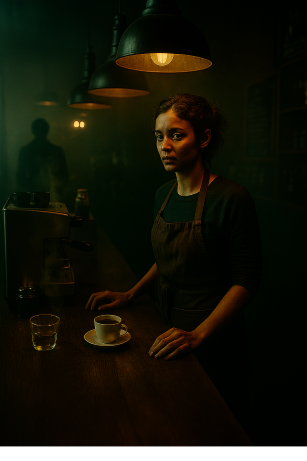
Tess has worked at The Daily Grind for three years. She knows the rhythms of the place the way a musician knows a familiar song:
- Mrs. Henderson: a latte at exactly 165 degrees every weekday at 8:05 AM.
- The construction crew: black coffee and bear claws at 6:15 AM sharp.
- College students: drifting in after 10 AM, laptops open, headphones on.
But it’s the Wednesday customer who stands out:
- Arrives every Wednesday at 2:47 PM.
- Orders a medium dark roast, one sugar, no cream.
- Pays cash.
- Leaves a two‑dollar tip.
- Sits in the corner booth facing the door.
- Never varies. Never lingers. Never chats.
This is where you, as the writer, lean into specificity. The exact time, the exact order, the exact tip—these details create a pattern the reader can feel. When you break it later, the disruption will land harder.
Part 2: The first disruption—a hairline crack in the pattern
In week five, Tess notices something different.
Wednesday Guy’s left hand is bruised—purple‑black, fresh, spread across his knuckles like spilled ink. He orders the same drink and sits in the same booth, but his posture has changed. He’s tense. Hyperaware. Watching the door with a vigilance that feels practiced rather than paranoid.
This is your curiosity hook. Tess isn’t a detective; she’s a barista with student loans and a cat named Fitzgerald. But she’s observant, and humans are wired to notice anomalies. She starts paying closer attention. So does the reader.
Part 3: The vanishing—when routine breaks
The next Wednesday, Tess glances at the clock.
2:47 PM passes. Then 3:00. Then 3:30.
No Wednesday Guy.
Real people don’t immediately assume foul play. Tess rationalizes:
- Maybe he’s sick.
- Possibly he’s traveling.
- Perhaps he found a better café (unlikely—The Daily Grind uses award‑winning local beans).
When he misses the second Wednesday, she feels a twinge of worry. By the third, she’s genuinely concerned. She asks her manager if anyone knows his name.
No one does.
No loyalty card. Not using a credit card. There is no idle chatter. Not a sign.
He’s a ghost who drinks coffee.
This is the moment the story shifts from curiosity to mystery. The pattern hasn’t just bent—it’s broken.
Part 4: Enter Mark Sullivan — the reluctant partnership
Most compelling mysteries pair an amateur with a professional. Not so the amateur can suddenly become Sherlock Holmes, but so each character brings a different skill set and worldview.
Mark Sullivan walks into the café on a Thursday. He orders black coffee, sits alone, and scans the room with the same watchfulness Tess once saw in Wednesday Guy. When she mentions her missing regular, Mark’s interest sharpens—not because a customer vanished, but because of the pattern she describes:
- Cash only.
- Clockwork timing.
- Door‑facing seat.
- Hyper‑vigilance.
“Sounds like someone who didn’t want to be found,” Mark says.
Tess realizes she may have stumbled into something far bigger than a broken habit. Mark, a detective reassigned to small‑town duty after a case went wrong in the city, recognizes the shape of a hidden life.
This is where you establish the reluctant partnership. Tess has access and observational insight; Mark has training and resources. Neither can solve this alone.
Part 5: The investigation begins—two skill sets, one mystery
Amateur‑sleuth stories often fail when civilians suddenly become experts in forensics, hacking, or interrogation. Instead, keep each character operating inside their believable lane.
Tess’s lane: observation and access
- Talks to regulars: Has anyone noticed Wednesday Guy elsewhere?
- Checks lost‑and‑found: Did he leave anything behind?
- Reviews security footage: The café only keeps two weeks of recordings—a frustrating but realistic limitation.
Mark’s Lane: Systems and patterns
- Runs descriptions through missing persons databases.
- Cross‑references: Similar reports from nearby towns.
- Searches for patterns: routine-driven men who suddenly vanish.
He finds something chilling: three other coffee shops in neighboring towns have reported similar “regulars” who disappeared around the same time. Middle‑aged men. Cash only. Creatures of habit. Gone.
The partnership is no longer optional. It’s inevitable.
Part 6: The first real clue—a phone call and a slip
The first major clue comes from an unexpected source: the teenage barista who works weekends.
She remembers Wednesday Guy receiving a phone call that made him go pale. He stepped outside to take it, but she overheard two phrases:
- “the shipment”
- “Tuesday instead”
Mark’s instincts flare. This sounds like a drop point—a neutral location where information or goods change hands. But what kind of operation uses suburban coffee shops as its infrastructure?
Tess remembers something else: Wednesday Guy always sat where he could see the community bulletin board.
Lost cats. Yoga classes. Garage sales. Or something more.
Part 7: The bulletin board cipher—ordinary messages, extraordinary meaning
This is where the story widens—from a missing man to a hidden system.
Mark and Tess notice that certain “lost cat” notices follow a pattern. The cats are always “found” exactly three days later. The phone numbers on the “found” notices trace to disconnected lines.
The real revelation lies in the descriptions:
- “Gray tabby with white paws.”
- “Orange male with green collar.”
- “Black kitten with blue tag.”
These correspond to shipping container codes at the nearby port—GTW‑4, OMG‑3, BKB‑2. The bulletin board isn’t just a community hub; it’s a coded messaging system.
The Daily Grind isn’t just a café. It’s a communication node in a larger network.
And Wednesday Guy? He wasn’t just a regular. He was a courier.
This is the moment your story shifts from personal mystery to conspiracy. The stakes expand beyond one missing man.
Part 8: The dangerous discovery—the flash drive
While examining the bulletin board more closely, Tess finds something wedged behind it: a flash drive. Hidden deep. Placed intentionally.
Mark knows someone who can decrypt it—a tech expert with their reasons for wanting this kind of operation exposed. This character adds a new skill set and a new emotional lens.
The contents of the drive are devastating:
- A human trafficking network using shipping containers to move people across borders.
- Coded instructions embedded in “lost pet” notices across multiple cafés.
- Logs of drop points, payments, and routes.
Then it gets personal. Among the images on the drive is a photo of Mark’s former partner—the one whose death ended his big‑city career. The case that broke him is connected to the network that now runs through Tess’s café.
The mystery is no longer abstract. It’s a chance at redemption.
Part 9: The hunter becomes the hunted — escalation
Once Tess and Mark start pulling threads, the network pulls back.
Strange cars appear outside Tess’s apartment. Mark discovers his brake lines have been cut. The Daily Grind experiences a series of “accidents”:
- A broken front window.
- A vandalized door.
- A fire in the dumpster out back.
The café, once a sanctuary of routine and comfort, becomes a potential trap.
Then Tess receives a package at work.
Inside are photos of her family: her sister’s kids at school and her parents at the grocery store. The message is clear:
Back off, or the people you love pay the price.
This is your point of no return. The stakes are now personal, immediate, and terrifying. Tess has to decide whether solving this mystery is worth risking everything.
Part 10: The unlikely alliance—unmasking the villain
Backing off isn’t in Tess’s nature. If it were, she never would have noticed Wednesday Guy’s absence in the first place.
She and Mark go underground, working with the tech expert to trace the network’s leadership. What they find subverts expectations.
The operation is run by a respected local businessman—a philanthropist, a sponsor of Little League teams, and a regular presence at town council meetings. He’s the kind of man people instinctively trust.
This is the power of the respectable villain. Evil wearing the mask of respectability is often more unsettling than a stereotypical criminal mastermind.
They also learn Wednesday Guy’s real name: David Chen, an undercover federal agent who got too close to the truth. His disappearance wasn’t random; it was a cleanup operation.
The mystery is now about more than one missing man. It’s about exposing a system that thrives on invisibility.
Part 11: The sting—the café becomes the stage
With federal agents now involved, Tess and Mark help orchestrate a sting operation. The café that once hosted quiet routines becomes the stage for the climax.
They post a fake “lost cat” notice designed to draw out key operatives. Agents position themselves throughout the café and surrounding streets. The plan is to capture the network’s leadership in one coordinated move.
But the businessman is too careful to appear in person. He sends underlings instead. The sting begins to falter—until Tess does something unscripted.
She recognizes one of the underlings as a semi‑regular customer and calls him by name. He panics and makes a phone call, which gives the feds the final piece they need to move on the entire network.
Chaos erupts:
- Agents burst through doors.
- Customers dive under tables.
- Coffee spills, cups shatter, and orders are abandoned mid‑pour.
In the end, the network is dismantled, the businessman is arrested, and dozens of trafficking victims are freed.
The café returns to silence—but it’s not the same silence as before.
Part 12: The new normal—routines return, but Tess doesn’t
After six months, The Daily Grind is back in working order. A digital community screen, which is far more difficult to hack for coded messages, has taken the place of the bulletin board.
Mark is offered his old job back in the city. He turns it down. He’s found something worth protecting here—a town, a café, and a barista who refused to look away.
On a Wednesday at 2:47 PM, the door chimes.
David Chen walks in. Alive, though worse for wear.
He orders a medium dark roast, one sugar, no cream. He leaves a two‑dollar tip.
Some routines, it turns out, are worth preserving.
Tess notices a new regular in the corner—someone whose behavior is just a little too careful, too observant. She exchanges a look with Mark, now a regular himself.
The adventure is over, but the vigilance continues. Because now they know:
The most ordinary places can hide the most extraordinary secrets.
How to use this 12‑part arc in your stories
What makes this structure powerful isn’t just the plot—it’s the way each beat builds on the last:
- Establish routine: Make the normal feel specific and lived‑in.
- Disrupt it: Introduce a small but undeniable fracture.
- Investigate: Let curiosity escalate into concern.
- Reveal a pattern: Connect the personal to something larger.
- Raise the stakes: Make the danger personal and irreversible.
- Confront the system: Unmask the hidden structure behind the mystery.
- Resolve and reset: Return to a new normal that carries the weight of what happened.
If this deep dive into pattern, disruption, and hidden lives resonates with you, you’ll find even more narrative‑driven guides across our Character Psychology, Morally Gray Protagonists, and Movies That Make You Feel Something categories. For stories that explore how identity fractures under pressure, our guide to movies like The Social Network examines ambition, secrecy, and the psychology of reinvention. If you’re drawn to narratives where ordinary people stumble into extraordinary danger, explore our breakdown of movies like The Truman Show, where routine becomes revelation. And if you gravitate toward stories that blend emotional depth with escalating tension, our guide to movies like Hidden Figures highlights characters who navigate high‑stakes systems with resilience and clarity. For more psychologically rich, story‑driven recommendations, explore our full archive of streaming guides.
FAQ: Building your own café‑based mystery
Do I have to use a café as my setting?
No, but you should choose a setting where routine is visible—a gym, a bus route, a library, or a diner. Anywhere people repeat behaviors in predictable ways can become fertile ground for a mystery built on disruption.
Can my protagonist be a professional detective instead of an amateur?
Absolutely. The key is contrast. If your protagonist is a professional, consider pairing them with an amateur who has access or insight they don’t. The dynamic between Tess and Mark works because each sees what the other can’t.
How dark should I go with the conspiracy?
That depends on your audience and genre lane. Human trafficking is a high‑stakes, high‑intensity choice that pushes the story into thriller territory. You could scale down to financial fraud, art theft, or political blackmail and still use the same 12‑part structure.
Can this structure work for a series?
Yes. This 12‑part arc can function as a single season of a show, a novel, or a multi‑episode podcast. You can also treat each “part” as an episode, with its mini‑arc, while the larger conspiracy unfolds across the season.
Where can I learn more about mystery and thriller story design?
You can explore more cinematic breakdowns, structural templates, and character‑driven analyses in the Story Structure hub on BackStoryMovies.
Quick quiz: Test your mystery‑arc instincts
1. Which element makes the disruption in this story feel powerful?
- A) The café is trendy and modern.
- B) The barista is secretly a hacker.
- C) The routine is specific and consistent before it breaks.
- D) The villain is wealthy.
Correct answer: C. The more specific the routine, the more impactful the disruption.
2. Why is the bulletin board such an effective story device?
- A) It’s visually interesting.
- B) It’s a familiar object hiding unfamiliar meaning.
- C) It lets you add more characters.
- D) It makes the café feel cozy.
Correct answer: B. It turns something ordinary into a coded communication system, reinforcing the theme of secrets in plain sight.
3. What makes the villain more unsettling?
- A) He’s a stranger from out of town.
- B) He’s a respected local businessman.
- C) He never speaks.
- D) He owns the café.
Correct answer: B. A respectable, integrated villain challenges the community’s assumptions and feels more psychologically disturbing.
4. What is the emotional core of Tess’s arc?
- A) Curiosity turning into obsession.
- B) Boredom turning into adventure.
- C) Routine turning into responsibility.
- D) Fear turning into apathy.
Best answer: C. She moves from passive observer of routine to someone who accepts responsibility for what she’s seen.
Call to action: Turn your own “ordinary place” into a mystery engine
You don’t need explosions, car chases, or exotic locations to build a gripping mystery. You need:
- A place where routines are visible.
- A character who notices when something breaks.
- A pattern that hides something larger.
- A choice that raises the stakes from curiosity to responsibility.
Take a setting from your life—a café, a bus stop, a coworking space, or a grocery store—and ask:
What happens if one tiny, predictable thing suddenly stops? Who notices? And what do they risk by caring?
When you’re ready to turn that spark into a full narrative, explore more cinematic templates, breakdowns, and story arcs at BackStoryMovies. Build your own 12‑part mystery and let your ordinary world become the birthplace of something extraordinary.
Grow through the stories that shape you!
If you’re exploring the backstories of movies, why not binge on these cinematic shorts! Plot twists that you never see coming, the “why” in what a story is teaching you, and the art of being seen—then join me on YouTube! I create thoughtful, cinematic lessons designed to help you see your life with more compassion, courage, and intention.
Subscribe to Back Story Movies on YouTube! →Did I forget to mention, get more creativity in your life and shop the merch at Creativity Is Expression! Visit now @