

Summary:
Every person reaches a point where their life story feels constricting, signaling a need for change. This narrative, shaped by experiences and beliefs, defines identity and behavior. However, it is not fixed; it can be rewritten by recognizing outdated scripts and choosing new actions that align with one's true self. Storytelling is a tool for identity transformation, allowing individuals to become the authors of their lives, shifting from inherited limitations to self-determined growth.
There’s a moment in every person’s life when the story they’ve been living suddenly feels too small. Not wrong. Not broken. Just… too tight, like a skin they’ve quietly outgrown.
It happens in the in-between places—the late-night quiet, the morning you wake up and feel a subtle misalignment, the conversation that echoes longer than it should. You feel it as a tension beneath the surface, a quiet pressure that says, This isn’t the whole truth of who you are.
Most people ignore that moment. They push it down, call it stress, call it confusion, call it “just a phase.” But you—the one reading this—you're here because you can feel the edges of your story shifting. You can sense the narrative you’ve been living is no longer the narrative you’re meant to carry forward.
And that’s the secret no one tells you:
Your life is not shaped by events. It’s shaped by the story you tell yourself about those events.
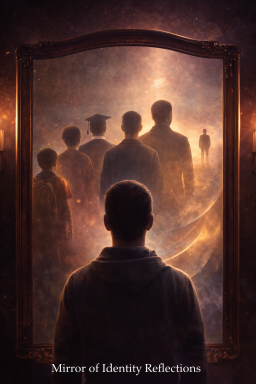
Storytelling isn’t entertainment. It’s identity architecture. It’s the psychological blueprint of whom you believe yourself to be—and who you allow yourself to become. This article is the mirror. Not the kind that shows you your face, but the kind that shows you your story—the one you inherited, the one you perform, and the one you’re finally ready to rewrite.
If you love exploring how stories shape identity, you’ll also enjoy our guide on how storytellers manipulate perspective through unreliable narrators.
Storytelling is the psychological process of shaping identity through narrative.
It’s how the mind organizes experience, assigns meaning, and constructs a coherent sense of self. Your internal story determines:
- how you interpret your past
- how you understand your emotions
- how you predict your future
- how you choose your relationships
- how you navigate your purpose
In identity psychology, storytelling is not a creative skill—it's a survival mechanism. Your brain uses narrative to make sense of chaos, to protect you from pain, and to maintain continuity between who you were and who you believe you are.
But here’s the part most people never learn:
Your internal narrative is editable. You can rewrite the story you inherited. You can dissolve the story you outgrew. Furthermore, you can author the story you’re becoming.
Storytelling is not just something you do. It’s something you are.
The Identity Architecture Behind Storytelling
Every identity is built on a story—not a factual one, but a psychological one. A story made of.
- emotional patterns
- subconscious beliefs
- inherited scripts
- unspoken rules
- internalized roles
- unresolved moments
- and the meanings you attached to them
This is what psychologists call narrative identity—the internal autobiography that explains who you are, why you are, and what you expect from life.
But here’s the twist:
Your narrative identity is not objective. It’s not neutral. It’s not even accurate.
Furthermore, it’s a collage of interpretations, emotional memories, and protective mechanisms. It’s the story your younger self created to survive a world they didn’t yet understand.
If you grew up needing to be the responsible one, your story became, “I must carry everything.” If you grew up needing to be invisible, your story became, “My needs don’t matter.” If you grew up having to be perfect, your story became, “If I’m not flawless, I’m unlovable.”
These stories were never chosen. They were inherited. And yet, they became the architecture of your identity.
But here’s the part that changes everything:
Your identity is not who you are—it's who you learned to be. And storytelling is how you unlearn it.
When you examine your internal narrative, you begin to see the seams. You begin to see the places where the story was shaped by fear instead of truth, by survival instead of sovereignty.
And once you see the story, you can rewrite it.
The Storytelling Framework
The Story You Tell Yourself Is Your Identity
Identity isn’t a fixed thing—it's a narrative you repeat until it becomes familiar enough to feel like truth.
If your story is, “I’m always the one who gets hurt,” you will unconsciously decide on relationships that confirm it. If your story is, “I’m not creative,” your mind will filter out every moment that contradicts it. You will squeeze yourself into spaces that were never intended for you if your narrative is one of “I'm too much.”
Your identity is not built from facts—it's built from meaning. And meaning is built from narrative.
The moment you change the story, you change the identity. The moment you change the identity, you change the behavior. The moment you change the behavior, you change the life. This is why storytelling is the most powerful psychological tool you have. It’s not about fiction. It’s about authorship.
Your Emotional Arc Reveals Your Patterns
Every person has an emotional arc—a recurring pattern of feelings that show up in different situations but trace back to the same internal wound.
Your emotional arc might be:
- abandonment
- invisibility
- responsibility
- inadequacy
- rejection
- unworthiness
- hyper‑independence
- perfectionism
These arcs are not random. They are the emotional spine of your story.
If your emotional arc is abandonment, your story becomes, “People always leave.” If your emotional arc is inadequacy, your story becomes, “I’m never enough.” If your emotional arc is hyper‑independence, your story becomes, “I can’t rely on anyone.”
But emotional arcs are not destiny. They are invitations—signals pointing to the part of your story that is ready to evolve. When you understand your emotional arc, you understand the chapter you’re currently living. And you understand the chapter you’re meant to write next.
Your Internal Script Predicts Your Behavior
Every person carries an internal script—a subconscious set of instructions that dictate how they show up in the world.
Scripts sound like:
- “Don’t need too much.”
- “Don’t take up space.”
- “Don’t be a burden.”
- “Don’t fail.”
- “Don’t trust anyone.”
- “Don’t show weakness.”
These scripts were written by earlier versions of you—versions who were trying to stay safe, accepted, or loved.
But here’s the truth:
Your internal script is outdated. It was written for a life you no longer live, by a self you no longer are. When you follow an old script, you repeat old outcomes. When you rewrite the script, you create new ones. Your behavior is not random. It is narrative. And once you see the script, you can choose a different scene.
To see how narrative perspective shapes meaning, explore our breakdown of movies with unreliable narrators. If you’re fascinated by how stories challenge assumptions, you’ll love our list of movies with plot twists that shatter reality. For a more in-depth look at how structure creates emotional impact, read our guide on the 12‑part mystery arc.
When you’re exploring identity through emotion, our collection of movies that make you feel something expands your emotional vocabulary. If you’re drawn to stories that rebuild self‑belief, explore our curated list of movies for when you need to believe in yourself again. To understand how truth becomes narrative, explore our guide to movies based on real events. And if you’re curious how stories transform across mediums, our breakdown of movies based on books is a perfect companion.
Your Protagonist Role Determines Your Choices
Every person unconsciously picks a role in their story. Not because it’s true—but because it’s familiar.
Some people select the supporting character, always orbiting someone else’s needs. Some pick the rescuer, carrying emotional weight that was never theirs. They pick the observer, watching life happen instead of participating. Some pick the villain, believing they are the source of every problem. Some pick the ghost, present but unseen.
And then there are the rare ones who decide the protagonist—not because they feel ready, but because they finally realize no one else can live their life for them.
Your protagonist role is not about confidence. It’s about authorship.
It’s the moment you stop waiting for permission. The moment you stop shrinking to fit someone else’s narrative. The moment you stop performing the version of you that kept you safe. When you decide the protagonist role, your choices shift. Your boundaries shift. Your relationships shift. There is a complete transformation in the trajectory of your identity.
Because the protagonist doesn’t ask, “Who am I allowed to be?” They ask, “Who am I becoming?”
→ Identity Reinvention Wallpapers
Your Narrative Tension Shows Where You’re Growing
Every story has tension—the friction between who the character is and who they’re becoming. Your life is no different.
Narrative tension shows up as:
- restlessness
- dissatisfaction
- emotional friction
- identity confusion
- the sense that something is “off”
- the quiet knowing that you’re meant for more
Most people misinterpret this tension as failure. They think something is wrong with them. They think they’re falling apart.
But narrative tension is not a breakdown—it's a threshold. It’s the psychological signal that your current identity can no longer hold the next version of you.
When you feel tension, it means:
- your story is expanding
- your identity is evolving
- your emotional patterns are shifting
- your internal script is dissolving
- your next chapter is calling
Tension is not the enemy. Tension is the invitation. It's the moment the story asks, “Are you willing to grow?”
Your Story Mirrors Your Self‑Worth
Your story is the mirror you hold up to yourself—and it reflects what you believe you deserve.
If your self‑worth is low, your story becomes small. You write yourself into roles that minimize your power. You choose relationships that confirm your fears. Furthermore, you accept opportunities that match your doubt, not your potential. If your self‑worth is wounded, your story becomes protective. You avoid risk. You avoid visibility. Likewise, you avoid anything that might expose the parts of you you’ve learned to hide.
But when your self‑worth begins to heal, your story expands.
You start selecting roles that honor your truth. You start writing chapters that reflect your potential. Not only that, but you start allowing yourself to want more—not because you’re entitled, but because you’re finally honest. Your story is not a reflection of your past. It’s a reflection of your self‑worth in the present.
Change the worth, and the story changes with it.
Your Identity Arc Is Still Being Written
Identity is not a fixed destination—it's an arc. A movement. A becoming.
Most people think identity is something you “find,” like a lost object. But identity is something you create, moment by moment, choice by choice, story by story.
Your identity arc is the path between:
- who you were
- who you pretended to be
- who you believed you had to be
- and who you’re finally ready to become
This arc is not linear. It loops. It spirals. Furthermore, it revisits old wounds with new wisdom. But it always moves forward. The most important truth you can hold is this:
You are not behind. You are not late. Furthermore, you are not stuck. You are mid‑arc.
Your story is not finished. Your identity is not finalized. You are the only one who can write the next chapter of your life.
→ Narrative Identity Micro‑Guide
Integration: How to Rewrite Your Internal Narrative
There comes a moment when insight is no longer enough. You can understand your emotional arc, your internal script, and your protagonist role—and still feel trapped inside the same story. That’s because identity doesn’t shift through awareness alone. Identity shifts through integration—the moment you begin living in alignment with the story you want to tell.
Here’s the truth most people never learn:
You don’t rewrite your story by thinking differently. You rewrite your story by choosing differently.
Choosing differently is the hinge.
The turning point.
The moment the narrative bends toward a new future.
1. Name the old story.
Say it plainly. Not poetically. Not dramatically. Just honestly.
- “I learned to be invisible.”
- “I learned to carry everything.”
- “I learned to earn love.”
- “I learned to stay small.”
Naming the story breaks the spell. It separates you from the narrative you inherited.
2. Identify the emotional pattern.
Ask yourself:
- What emotion repeats?
- What wound does it trace back to?
- What belief does it reinforce?
Your emotional arc is the compass. It points to the chapter that needs rewriting.
3. Rewrite the internal script.
Not with affirmations—with truth.
Affirmations try to overwrite the story. Truth rewrites it from the inside.
Truth sounds like:
- “I deserved more than I received.”
- “I was never too much—I was unheld.”
- “I wasn’t unworthy—I was unmirrored.”
- “I wasn’t dramatic—I was overwhelmed.”
Truth is the solvent that dissolves old scripts.
4. Decide the new protagonist role.
Not the hero. Not the savior. Not the martyr.
The author.
The one who decides the arc. The one who chooses the direction. The one who writes the next chapter.
5. Take one aligned action.
Not ten. Not a reinvention. Not a transformation.
Just one.
Because identity doesn’t change in leaps. It changes in increments—small choices that accumulate into a new narrative. And here’s the part that matters most:
You don’t become a new person. You become the person you were always meant to be—the one beneath the old story.
FAQ
What is narrative identity?
Narrative identity is the internal story you use to explain who you are, why you are the way you are, and what you expect from your future. It’s built from emotional memories, subconscious beliefs, and the meanings you attached to experiences. Your narrative identity shapes your behavior, relationships, and sense of purpose.
How does storytelling shape your personality?
Storytelling shapes personality by influencing how you interpret events, assign meaning, and predict outcomes. The story you tell yourself becomes the filter through which you see the world. If your story is rooted in fear or inadequacy, your personality adapts to protect you. If your story is rooted in truth and self‑worth, your personality expands.
How do I rewrite the story I tell myself?
You rewrite your story by identifying your old narrative, understanding the emotional pattern behind it, challenging the beliefs that formed it, and choosing new behaviors that align with the identity you want to embody. Story rewriting is not mental—it's behavioral. One aligned action can shift the entire arc.
Why do people repeat the same emotional patterns?
People repeat emotional patterns because the brain seeks familiarity, not happiness. Old patterns feel safe, even when they’re painful. These patterns are tied to early experiences and internal scripts that were formed to protect you. Until the script is rewritten, the pattern repeats.
How do I become the protagonist of my life?
You become the protagonist by deciding authorship over autopilot. This means setting boundaries, telling the truth, honoring your needs, and making decisions based on who you’re becoming—not who you’ve been. The protagonist doesn’t wait for permission. They write the next chapter.
In Closing,
There is a moment—quiet, subtle, almost imperceptible—when the story you’ve been living loosens its grip. You feel it like a soft exhale, a shift in the weight you’ve been carrying, a widening in the space around your name.
That moment is now.
Not because you’re ready. Not because you’re healed. It is not because you have resolved all issues.
But because you finally understand the truth:
Further Reading
Your story is not a prison. It’s a doorway.
And you are standing at the threshold—pen in hand, heart awake, identity unfolding—ready to write the chapter only you can live.
Your story is still being written. And this time, you’re the one holding the narrative.
Reliable Sources
- The Narrative Mind: Why We Turn Life into Stories. GlobalRPh↩
- Guber, Peter. The Inside Story↩
- The Psychology Behind Storytelling. Liberty University Faculty Share↩
- Stories and Storytelling: The Science of Storytelling. The Human Journey↩
- Suskind, Dorothy. The Power of Story: How the Stories We Tell Shape Our Lives↩
- Johnson, Julie. How Your Story Shapes Your Future↩
- Ron, Shlomi. How Do Stories Shape Reality?↩