
Summary:
Exploring films similar to “The Hunger Games,” the post highlights three movies—“Divergent,” “The Maze Runner,” and “Snowpiercer”—that share themes of rebellion, survival, and power dynamics. These films resonate with fans of “The Hunger Games” through their portrayal of reluctant heroes challenging oppressive systems, with each narrative offering a unique take on identity, control, and societal structures.
3 Cinematic Worlds of Rebellion, Survival, and Power
The first time you watch The Hunger Games, something inside you tightens. Not because of the spectacle—but because of the quiet moments before the violence. The way Katniss steadies her breath before volunteering. The way the Capitol smiles while children are chosen to die. The way rebellion begins is not with a weapon but with a choice.
If you’re searching for movies like The Hunger Games, you’re not just looking for dystopia. You’re looking for stories where:
- Survival is political
- rebellion is personal
- power is a weapon
- ordinary people become symbols
The three films below don’t just resemble The Hunger Games—they echo its emotional architecture, its psychological stakes, and its cinematic DNA. This is a deep‑dive guide, written for viewers who care about storytelling and narrative craft, emotional intent, and the psychology behind the spectacle.
Why The Hunger Games Resonates (Before We Begin)
Katniss Everdeen is one of the most emotionally complex protagonists in modern YA cinema—and understanding her emotional blueprint helps explain why certain films feel like The Hunger Games even when the settings differ.
Backstory of Katniss Everdeen
- Grew up impoverished in District 12
- Lost her father in a mining explosion
- Became the family provider at 11
- Learned to hunt to survive
- Developed emotional restraint as a survival mechanism
- Never wanted to be a symbol—but became one anyway
“Katniss isn’t fighting to win. She’s fighting to protect the people she loves — and that’s what makes her dangerous.”
Her arc is the backbone of the franchise: a journey from survival to symbolism. If you want to go deeper into characters like Katniss, Tris, Thomas, or Curtis, you can explore more in Character Psychology, where emotional architecture takes center stage.
What Makes a Movie “Hunger Games‑Like”? (Director’s Scope)
Directors who create films in the same lineage as The Hunger Games often lean into:
- world‑building shaped by oppression
- youth vs. authoritarian systems
- Violence framed as spectacle
- characters forced into moral dilemmas
- rebellion as identity
- trauma as transformation
- the psychology of survival
These elements shape the three films below—each chosen for emotional resonance, thematic depth, and cinematic parallels. For more on how directors construct these worlds, your readers can dive into Behind the Scenes and Original Stories & Emotional Worlds.
The 3 Best Movies Like The Hunger Games (Deep Cinematic & Psychological Breakdown)
These aren’t just “similar movies.” They’re films that share the same emotional DNA: reluctant heroes, rigged systems, and rebellions that cost more than anyone expects.
1. Divergent (2014)
Why It’s Similar
- A rigidly controlled society divided into factions
- A young woman who doesn’t fit the system
- Government surveillance and ideological control
- Rebellion sparked by identity
- A heroine shaped by trauma and loyalty
Narrative Breakdown
Tris Prior’s world is built on the illusion of order. Society is split into factions—Abnegation, Dauntless, Erudite, Amity, and Candor—each representing a single virtue. The system promises peace, but what it really delivers is predictability and control.
When Tris tests as “Divergent,” she becomes a threat simply by existing. The system can’t categorize her, and therefore it can’t control her. That’s the same narrative pressure that shapes Katniss: a girl who doesn’t want to be a symbol but whose very existence destabilizes the regime.
This kind of structure—where identity itself becomes rebellion—is precisely the kind of narrative you explore in Storytelling & Narrative Craft and Movies Like.
Backstory of Tris Prior
- Born into Abnegation, a faction built on selflessness
- Never fully felt like she was her family’s value system
- Grew up watching quiet corruption beneath the surface of “order”
- Chooses Dauntless, not because she’s fearless, but because she’s tired of disappearing
- Loses her parents during the uprising and carries deep survivor’s guilt
Her emotional arc mirrors Katniss’s: identity → resistance → symbol → sacrifice. Both characters are forced to reconcile who they are with what the world needs them to be.
Director’s Vision
Neil Burger frames the world of Divergent through visual and structural fragmentation. Each faction has its aesthetic, rhythm, and emotional tone. The more Tris moves between them, the more the audience feels the artificial nature of the system.
“Divergence isn’t a flaw. It’s the system’s fear.”
The film leans into the idea that systems don’t just control behavior—they control identity. That’s the same thematic backbone that makes The Hunger Games so powerful.
Why Hunger Games Fans Love It
If you loved watching Katniss navigate the Capitol’s expectations while trying to stay true to herself, Tris’s journey will feel familiar. Both stories ask:
What happens when a girl who never wanted power becomes the only one brave enough to challenge it?
For more films that hit this emotional nerve, your readers can explore Movies That Make You Feel Something and Emotionally Intent Movies.
2. The Maze Runner (2014)
Why It Works
- Teenagers trapped in a deadly system
- Memory loss used as a tool of control
- Survival framed as a psychological experiment
- A reluctant leader emerges from chaos
Narrative Breakdown
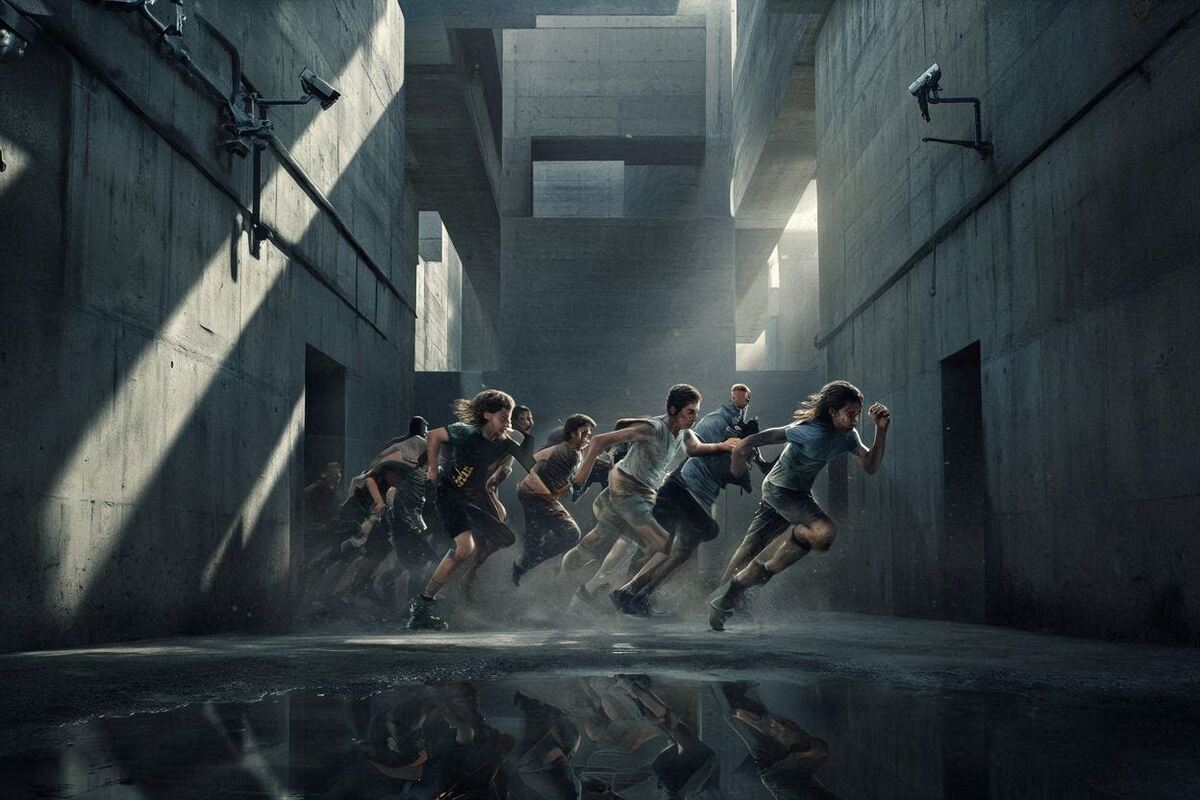
Thomas wakes up in a metal elevator with no memory of who he is. When the doors open, he’s pulled into the Glade—a makeshift society built by boys who arrived the same way. Surrounding them is the Maze: a shifting, lethal structure that closes every night.
The Maze functions like a compressed version of Panem:
- It’s a controlled environment.
- It’s monitored by unseen adults.
- It’s designed to test, break, and sort human beings.
The boys in the Glade have created rules, roles, and routines—similar to the districts in The Hunger Games. But the system is still rigged. The illusion of order is just another layer of control.
This kind of world-building—where the setting itself is an antagonist—fits beautifully into your Original Stories & Emotional Worlds and Movies With Vibe categories.
Backstory of Thomas
- Former test subject for WCKD, chosen for his intelligence and empathy
- Had his memory wiped to ensure compliance and “objectivity”
- Arrives in the Glade with a subconscious sense that something is wrong
- Driven by instinct to protect others, even before he understands the stakes
- He becomes a leader not because he wants to, but because no one else will
Thomas and Katniss share the same emotional blueprint: trauma leads to clarity, clarity leads to rebellion, and rebellion leads to responsibility. Neither of them wanted to lead—the system forced them into it.
Director’s Vision
Wes Ball uses the Maze as a visual metaphor for systemic manipulation. It’s constantly shifting, impossible to fully map, and designed to keep its subjects in a state of fear and uncertainty.
“The Maze isn’t meant to be solved. It’s meant to be survived.”
That’s the same emotional tension that runs through the Hunger Games arena: the game is never just about winning—it's about what the game does to you.
Why Hunger Games Fans Love It
If you were drawn to the arena sequences in The Hunger Games—the traps, the alliances, the moral compromises—The Maze Runner will feel like a natural extension of that tension.
It asks:
What does it mean to fight a system that’s already decided your fate?
For readers who love decoding endings and hidden systems, you can point them toward Movie Explanations and Trending Movies.
3. Snowpiercer (2013)
Why It Belongs Here
- A rigid class hierarchy enforced by violence
- A rebellion that starts at the bottom and moves forward
- Survival as political resistance
- Violence used as spectacle and control
- A system built on exploitation and denial
Narrative Breakdown
After a failed climate experiment freezes the planet, the last remnants of humanity live on a perpetually moving train. The poor are crammed into the tail, surviving on protein blocks. The wealthy live in luxury near the front.
The train is a perfect metaphor for a closed system:
- Every car represents a class, a function, or a lie.
- The track is fixed—there is no “off.”
- The illusion of balance is maintained through brutality.
Curtis, like Katniss, is a reluctant revolutionary. He would rather not be the face of anything. He just wants the people he loves to stop suffering. But the only way to do that is to move forward—car by car—toward the engine.
Backstory of Curtis Everett
- Survived the earliest, most brutal days in the tail section
- Witnessed cannibalism and unthinkable acts committed in desperation
- Carries deep shame over what he did to survive
- Fears leadership because he knows what he’s capable of
- Accepts responsibility not because he believes he’s worthy, but because someone has to
His emotional arc is one of the most Katniss‑like in modern cinema: a person who never wanted to be a symbol, forced to confront the cost of becoming one.
Director’s Vision
Bong Joon‑ho uses the train as a literal and visual metaphor for class hierarchy. Each car is a new revelation: a school indoctrinating children, a nightclub distracting the privileged, and a greenhouse feeding the illusion of sustainability.
“Rebellion is not about reaching the front. It’s about breaking the track.”
The film doesn’t just ask whether the system can be overthrown—it asks whether the system itself is the problem. That’s a question that sits just beneath the surface of The Hunger Games as well.
Why Hunger Games Fans Love It
If you were drawn to the class divide between the Capitol and the districts, Snowpiercer will feel like a darker, more concentrated version of that conflict. It’s not YA, and it’s more violent, but the emotional stakes are familiar:
What happens when the oppressed finally reach the engine of the system that controls them?
For viewers who love bold, allegorical storytelling, this pairs beautifully with your World Cinema and Movies With Vibe sections.
Comparison Table: The 3 Best Movies Like The Hunger Games
| Movie | Core Themes | Why It Resonates with Hunger Games Fans |
|---|---|---|
| Divergent | Identity, rebellion, surveillance | Mirrors Katniss’s reluctant‑hero arc and systemic control through factions |
| The Maze Runner | Survival, control, manipulation | Teens trapped in a deadly system designed to test and break them |
| Snowpiercer | Class warfare, revolution, exploitation | Rebellion against a closed, hierarchical system with no escape |
Internal Linking & Discovery Pathways
To keep readers exploring your cinematic universe, you can naturally guide them to:
- Movies Like — for more recommendation‑driven guides.
- Movie Explanations — for endings, symbolism, and narrative breakdowns.
- Emotionally Intent Movies — for films chosen by how they make you feel.
- Movies That Make You Feel Something — for emotional‑first viewing.
- Streaming — for where to watch these titles.
- Movies Based On — for adaptations like The Hunger Games and Divergent.
- Movies About Love, Loss & Relationships — for the emotional core beneath the dystopia.
- Books That Make You Feel Something — for readers who want to go back to the page.
FAQs
1. What movie is most similar to The Hunger Games?
Divergent is the closest match in terms of structure, themes, and emotional arc. It features a young woman who doesn’t fit into a rigid system, becomes a threat by existing, and is pushed into rebellion she never asked for.
2. Which film has the same political intensity?
Snowpiercer is the most politically intense of the three. It’s a sharper, more adult exploration of class, power, and systemic exploitation—like the Capitol vs. districts dynamic turned into a single, claustrophobic setting.
3. Which movie matches the survival‑game tension?
The Maze Runner captures the survival‑game tension best. The Maze functions like a psychological arena: shifting rules, hidden threats, and a system that treats human lives as data points.
4. Are these movies appropriate for teens?
Divergent and The Maze Runner are generally teen‑friendly, similar to The Hunger Games in tone and intensity. Snowpiercer is more mature, with heavier violence and darker themes, and is better suited for older teens and adults.
5. What should I watch after these three?
If you want to keep exploring dystopian and emotionally charged stories, try The Giver, The Darkest Minds, or Battle Royale. You can also browse more in Movies Like and Seasonal Guides for curated watchlists.
Want More Cinematic Psychology?
If you love discovering movies like The Hunger Games through emotional depth, narrative structure, and psychological insight, explore more in Movies Like. From dystopian rebellions to intimate character studies, you’ll find guides that don’t just tell you what to watch—they help you understand why it hits so hard.

Emotional Closing
Stories like The Hunger Games stay with us because they remind us of something universal:
Even in the darkest systems, one act of courage can rewrite the world.
Whether it’s Katniss stepping forward, Tris choosing her faction, Thomas running into the Maze, or Curtis walking toward the engine—these characters show us that rebellion doesn’t start with a weapon.
It starts with a choice. And occasionally, that’s enough to change everything.
Sources
- “Divergent (2014) – Production Notes & Director Interviews.” IMDb
- “The Maze Runner (2014) – Behind the Scenes & Cast Commentary.” IMDb
- “Snowpiercer (2013) – Director Bong Joon‑ho on Class Metaphors.” Roger Ebert.
- “Suzanne Collins Discusses Themes of Power & Rebellion in The Hunger Games.” Scholastic Interview.
- “YA Dystopian Cinema: The Rise of Teen Rebellion Narratives.” The Guardian – Film.
- “Bong Joon‑ho Explains the Social Hierarchy of Snowpiercer.” Vulture Interview.
- “The Maze Runner: Themes of Control & Experimentation.” ScreenRant Analysis.
- “Divergent’s Faction System and Identity Politics.” Polygon – Movies.
- “Snowpiercer: Class Warfare on a Train.” IndieWire
- “The Hunger Games: Themes of Survival, Power, and Spectacle.” The New York Times Review.
Grow through the stories that shape you!
If you’re exploring the backstories of movies, why not binge on these cinematic shorts! Plot twists that you never see coming, the “why” in what a story is teaching you, and the art of being seen—then join me on YouTube! I create thoughtful, cinematic lessons designed to help you see your life with more compassion, courage, and intention.
Subscribe to Back Story Movies on YouTube! →Did I forget to mention, get more creativity in your life and shop the merch at Creativity Is Expression! Visit now @