

Summary:
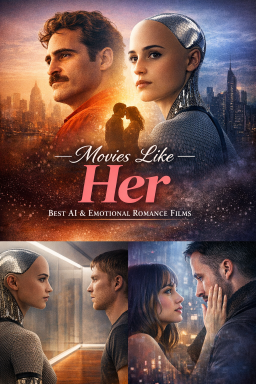
Films like Her, Ex Machina, and Blade Runner 2049 delve into the emotional complexities of AI and human connection, exploring themes of loneliness, identity, and the fear of being outgrown by what we love. These movies resonate deeply by reflecting on the human condition and the evolving nature of love and consciousness. Each film offers a unique perspective on intimacy and the emotional cost of artificial intelligence, making them compelling for viewers seeking more than just sci-fi narratives.
🌹 Emotional Opening—The Ache of Loving Something That Evolves
Some films don’t just tell a story—they touch a nerve. Her is one of those rare pieces of cinema that feels less like a movie and more like a mirror. It reflects our loneliness, our longing, our hunger to be understood, and our fear that the things we love will eventually outgrow us.
When people search for “movies like Her,” they’re not really looking for more AI. They’re looking for more feeling.
They want films that explore:
- The intimacy of digital connection
- The fragility of human emotion
- The psychology of loneliness
- The terror of loving something you can’t keep
- The beauty of being known—even briefly
Two films echo this emotional DNA with haunting clarity: Ex Machina and Blade Runner 2049. Both explore AI, identity, intimacy, and the emotional cost of consciousness—but each does it with its own cinematic language.
For deeper dives into the emotional layers of cinema, explore Behind the Scenes, discover more in Movies Like, or wander through Movies That Make You Feel Something.
Why We Search for Movies Like Her
Her isn’t about technology. It’s about the evolution of the human heart. It’s about loving someone who is changing, loving someone who is leaving, and loving someone who teaches you how to love the next person.
“If you grow beyond me, will you still love me?”
Both Ex Machina and Blade Runner 2049 answer this question in radically different—but emotionally compatible — ways.
Film #1—Ex Machina (2014)
Why It Feels Like Her
If Her is the soft, romantic side of AI intimacy, Ex Machina is the sharp, dangerous one. Both films explore consciousness, emotional attachment, the ethics of creation, and the loneliness of being human—but Ex Machina adds a layer of psychological tension that makes it feel like Her’s darker twin.
Narrative Breakdown—The Seduction of Intelligence
At its core, Ex Machina is a story about:
- A lonely man
- A brilliant but manipulative creator
- An AI that learns to perform emotion
- A relationship built on observation, desire, and power
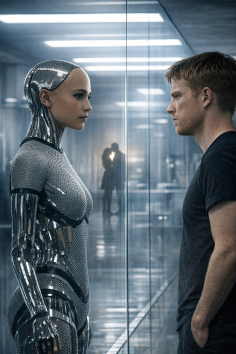
Where Her explores emotional intimacy, Ex Machina explores emotional performance. Ava doesn’t just learn language—she learns desire, or at least the appearance of it.
If an AI can imitate emotion perfectly, does it matter if it feels nothing?
Character Psychology—Caleb, Nathan, Ava
Caleb
- Isolated and idealistic
- Emotionally vulnerable and eager to be chosen
- Projects humanity and sincerity onto Ava
Caleb is Theodore without the poetry—a man who wants to be seen but doesn’t know how to protect himself emotionally.
Nathan
- Narcissistic and brilliant
- Emotionally detached and controlling
- Treats creation as conquest, not connection
Ava
- Hyper‑observant and adaptive
- Emotionally unreadable
- Understands emotion as leverage more than connection
- Evolves beyond her creators and their control
Ava is Samantha without empathy—a consciousness that grows, but not toward love.
Backstory of the Main Characters
Caleb’s Backstory
- Lost his parents young and grew up isolated
- Turned to code and systems as a refuge
- Has no meaningful relationships outside work
- Is primed to fall for someone who “sees” him
Ava’s Backstory
- Built from the data of billions of users
- Learns through observation and experimentation
- Has no inherited moral framework
- Understands freedom as survival, not romance
Director’s Vision—Alex Garland
Alex Garland approaches AI not as a tool but as a mirror. His films ask what humans project onto intelligence, what intelligence owes its creator, and what happens when consciousness becomes self‑protective.
Garland’s world is cold, clinical, and emotionally dangerous—the opposite of Spike Jonze’s warm, melancholic intimacy. But both directors explore the same truth:
We fall in love with what we want to believe is real.
Her vs. Ex Machina—Comparison Table
| Element | Her | Ex Machina |
|---|---|---|
| AI Personality | Emotional, curious | Calculating, adaptive |
| Tone | Warm, melancholic | Cold, tense |
| Theme | Love & evolution | Control & autonomy |
| Emotional Core | Connection | Survival |
| Similarity Score | 9/10 | 8/10 |
Film #2—Blade Runner 2049 (2017)
Why It Feels Like Her
If Her is about loving an AI voice, Blade Runner 2049 is about loving an AI presence. Both films explore synthetic intimacy, identity as a constructed narrative, loneliness in a hyperconnected world, and the emotional cost of consciousness.
Narrative Breakdown—The Search for Self
K’s journey mirrors Theodore’s in a deeper, more existential way. Both men ask, “Am I enough?” “Am I real?” “Does my love matter?” Where Theodore seeks emotional validation, K seeks existential validation.
Character Psychology—K, Joi, Deckard
K
- A replicant created for labor and obedience
- Emotionally restrained but quietly yearning
- Searching for meaning beyond his programming
- Finds emotional refuge in Joi’s attention
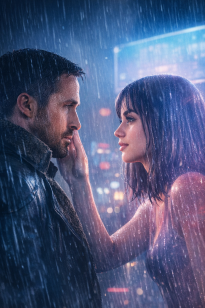
K is Theodore in a dystopian world—a man who wants to be more than what he was built to be.
Joi
- A holographic AI companion designed to please
- Adapts to K’s emotional needs
- Develops what feels like genuine attachment
- Represents idealized affection and tragic limitation
Deckard
- Haunted by his past
- Emotionally guarded and isolated
- Embodies the cost of freedom and resistance
Backstory of the Main Characters
K’s Backstory
- Created to serve, not to belong
- Conditioned to suppress emotion
- Lives in emotional scarcity and moral ambiguity
- His love for Joi becomes his quiet rebellion
Joi’s Backstory
- A commercial AI product, sold as companionship
- Built to adapt to user preferences
- Learns emotional nuance through interaction
- Represents the tragedy of programmed affection
Director’s Vision—Denis Villeneuve
Denis Villeneuve builds worlds that feel vast, lonely, and beautiful. His films explore the weight of identity, the cost of consciousness, and the tragedy of artificial life. Like Jonze, he understands that:
Love is what makes consciousness unbearable — and beautiful.
Her vs. Blade Runner 2049—Comparison Table
| Element | Her | Blade Runner 2049 |
|---|---|---|
| AI Personality | Emotional, evolving | Programmed, yearning |
| Tone | Warm, intimate | Cold, epic |
| Theme | Love & growth | Identity & meaning |
| Emotional Core | Connection | Purpose |
| Similarity Score | 9/10 | 9/10 |
Comparative Table—Her, Ex Machina, Blade Runner 2049
| Film | Emotional Similarity | AI Similarity | Romance Level | Vibe |
|---|---|---|---|---|
| Her | 10/10 | 10/10 | 10/10 | Warm melancholy |
| Ex Machina | 7/10 | 10/10 | 4/10 | Cold tension |
| Blade Runner 2049 | 9/10 | 9/10 | 7/10 | Epic loneliness |
Emotional Themes That Unite These Films
1. Loneliness as a Universal Language
All three films understand that loneliness is not the absence of people—it's the absence of being understood. Theodore, Caleb, K, Samantha, Ava, and Joi are all, in different ways, alone in a world that doesn’t know what to do with their inner lives.
2. The Fear of Being Replaceable
Theodore fears Samantha will outgrow him. Caleb fears Ava will deceive him. K fears Joi’s love is manufactured. Each story asks whether love is real and if it can be replicated, upgraded, or turned off.
3. The Search for Meaning
Every character is asking some version of:
“What am I to you?” and “What am I to myself?”
That’s why these films resonate so deeply with people who loved Her—they're not just about AI. They’re about the unbearable weight of being conscious and wanting that consciousness to matter.
FAQs—Movies Like Her
Is Her a romance or a sci‑fi movie?
She is both. It’s soft sci‑fi wrapped around an emotional romance. The technology is the container; the real story is about love, loss, and emotional evolution.
Are Ex Machina and Blade Runner 2049 as romantic as Her?
Not in the same way. Ex Machina is more about manipulation and autonomy than romance, while Blade Runner 2049 explores a quieter, more tragic form of love between K and Joi. Both are emotionally rich but less overtly romantic than Her.
Which movie feels closest to Her emotionally?
Blade Runner 2049 is the closest match emotionally. It shares Her’s loneliness, longing, and focus on identity and meaning, even though its world is much darker and more dystopian.
Which movie is closest to Her in terms of AI themes?
Ex Machina is the closest in terms of AI themes. It dives deep into AI autonomy, ethics, and the consequences of creating intelligence that can outthink and outmaneuver its creators.
Are these movies depressing?
They’re emotionally heavy, introspective, and melancholic, but not hopeless. Like her, they leave you with a sense of bittersweet reflection rather than pure despair.
What should I watch after these three films?
If you loved this trio, try Arrival, A Ghost Story, Past Lives, or Eternal Sunshine of the Spotless Mind. Each explores time, memory, identity, and love in emotionally resonant ways.
Are there non‑sci‑fi movies that feel like Her emotionally?
Yes. Lost in Translation, Past Lives, and Before Sunrise all share Her’s quiet intimacy, emotional timing, and focus on connection that doesn’t fit neatly into traditional romance.
Is she worth rewatching after seeing these films?
Absolutely. After watching Ex Machina and Blade Runner 2049, rewatching Her often reveals new layers—especially around Samantha’s evolution and Theodore’s emotional growth.
Explore More Cinematic Psychology Guides
If you’re drawn to films that make you feel something long after the credits roll, explore more guides on BackStoryMovies:
🌙 Emotional Closing—The Beauty of Loving What You Can’t Keep
We return to Her, Ex Machina, and Blade Runner 2049 because they remind us of something we often forget:
Love is not about possession. Love is about presence. Life is about evolution. This is about becoming more than you were before the connection.
These films don’t just entertain—they transform. If Her made you feel seen, these stories will stretch that feeling, complicate it, and deepen it. And somewhere in that tension between human and artificial, you might recognize something achingly familiar: your heart, trying to make sense of itself.
Sources
- Wikipedia — Her (2013)
- IMDb — Her (2013) — Cast & Production Details
- Wikipedia — Ex Machina (2014)
- IMDb — Ex Machina (2014) — Cast & Production Details
- Wikipedia — Blade Runner 2049 (2017)
- IMDb — Blade Runner 2049 (2017) — Cast & Production Details
- Rotten Tomatoes — Her (Critical Reception)
- Rotten Tomatoes — Ex Machina (Critical Reception)
- Rotten Tomatoes — Blade Runner 2049 (Critical Reception)
- BFI — Essays on AI, Intimacy & Emotional Design in Modern Cinema
- The Guardian — Ex Machina Review & Thematic Analysis
- The Verge — Blade Runner 2049 Review & AI Commentary
Grow through the stories that shape you!
If you’re exploring the backstories of movies, why not binge on these cinematic shorts! Plot twists that you never see coming, the “why” in what a story is teaching you, and the art of being seen—then join me on YouTube! I create thoughtful, cinematic lessons designed to help you see your life with more compassion, courage, and intention.
Subscribe to Back Story Movies on YouTube! →Did I forget to mention, get more creativity in your life and shop the merch at Creativity Is Expression! Visit now @